There was a time, not long ago, when Kirsten Dunst might’ve considered revisiting Bring It On. But this week, she made her position clear: that door is closed.
“I’m like, leave good things where they are,” Dunst told Entertainment Tonight. “I don’t need to put on a cheerleading outfit. I don’t even know what I would do—be a coach or something? Let’s leave it.”
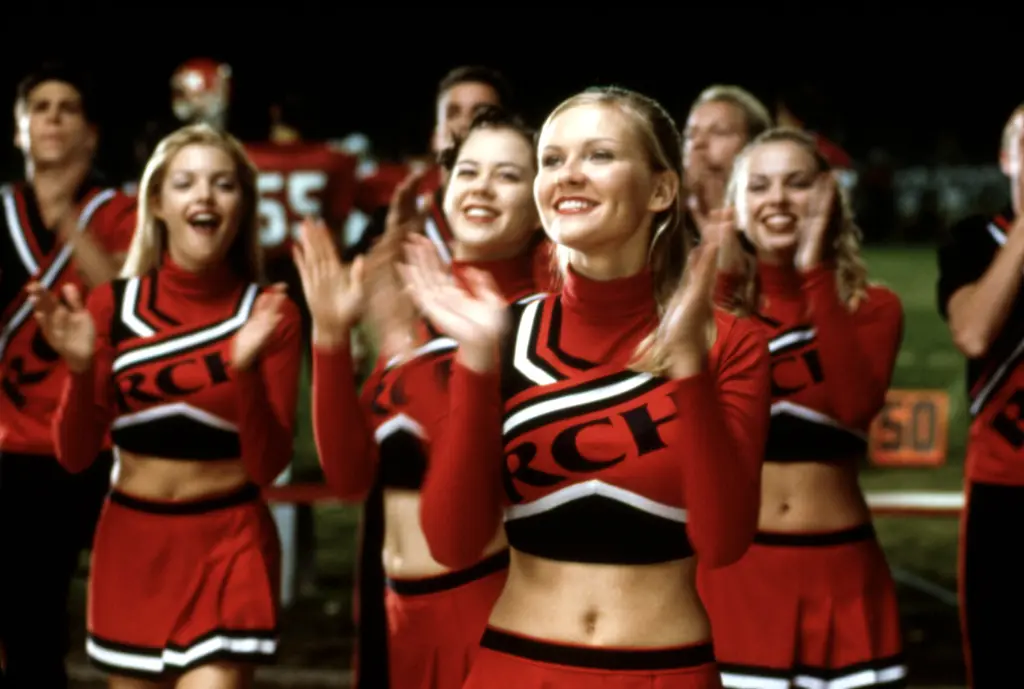
At 43, Dunst is no longer interested in reprises for the sake of nostalgia. And while her role as Torrance Shipman in the 2000 cult favorite remains one of the most quoted characters in teen film history, she seems uninterested in replicating it.
Not because she lacks affection for the film, but because she understands its precise place in time.
Released in August 2000, Bring It On arrived as a teen comedy with unexpected bite—underpinned by themes of cultural appropriation, performance politics, and athletic ambition. Dunst’s character, a newly minted high school cheer captain, was written with more dimensionality than the genre often afforded. She was ambitious, unsure, and eager to do the right thing—even when she didn’t know what that was.
The film went on to become a franchise—six sequels followed, none of which included Dunst—but it was the original that endured, helping to recalibrate how cheerleading was seen: not as background noise for football, but as choreography, strategy, and effort.
That Bring It On is still culturally relevant says as much about the sport of cheerleading—now global, Olympic-recognized, and explosively digital—as it does about the film.
In 2024, Dunst attended a screening of the film at Los Angeles’ Hollywood Forever Cemetery. When she stood to address the crowd, it wasn’t as a performer returning to a role—it was as a woman acknowledging the space that role occupies in other people’s memories.
“I am T-T-T-Torrance. Your Captain Torrance!” she shouted, playfully, before watching the film with fans for the first time since she was a teenager. “This is the craziest thing I’ve ever witnessed in my life. I’m so honored.”
It was a moment of gratitude, not reclamation. And that distinction matters.
In her more recent interviews, Dunst has offered a glimpse into her present—not just as an actress, but as a mother of two navigating both career and care.
While filming The Entertainment System Is Down in Budapest earlier this year, her youngest son, James, experienced a “serious health scare.” Her husband, Jesse Plemons, returned to Los Angeles with their children, leaving Dunst briefly alone abroad.
“I felt like I was in Final Destination, imagining all the worst-case scenarios,” she said. “That’s how it feels to be a mother at times.”
The family is safe now, and the experience—she says—brought them closer.
Dunst has never been an actor drawn to revival for revival’s sake. Her post-Bring It On career has been defined by deliberate roles: Melancholia, The Power of the Dog, The Beguiled. Work that asks something quieter, less performative.
She’s spoken with characteristic candor about wanting projects with creative weight—and occasionally, a paycheck. “Maybe I can just make a movie where I don’t lose money,” she joked to Town & Country, referencing the upcoming Minecraft film.
Her refusal to return to Bring It On isn’t a rejection of the past. It’s a refusal to dilute it.
It’s been 25 years since Torrance Shipman led the Toros to Nationals. Since then, cheerleading has evolved into a sport of intense complexity and global reach, with over 3.8 million athletes in the U.S. and a sports recognition with the IOC on its path to the Olympic Games.
In many ways, Bring It On was a cultural accelerator. But what made it endure was Dunst’s performance: full of contradiction, sincerity, and presence. That doesn’t need a sequel. It never did.
For more stories at the intersection of culture and cheerleading, visit cheerdaily.net