


Jeff Webb spent more than five decades building today’s cheerleading industry.
From summer training camps to packed national championships, from the growth of all star cheer to the push for Olympic recognition, the structure of the sport today reflects ideas Webb began pursuing in the 1970s. For millions of athletes who entered cheerleading over the past half century, the system they competed in was shaped directly or indirectly by his work.
Webb died March 19, 2026, at the age of 76 after suffering a sports related injury two weeks earlier. According to an email sent to employees by Varsity Spirit president Bill Seely, Webb had been hospitalized following the accident and was later removed from life support.
News of his passing spread quickly across the cheerleading community, the industry he had helped build and dominate for decades.
Few individuals have had a comparable influence on a single sport.
A Vision Beyond the Sidelines
Webb’s entry into cheerleading began at the University of Oklahoma, where he served as a yell leader during his college years. At the time, cheerleading was largely defined by sideline crowd leadership at football and basketball games.
The activity had not yet developed the competitive structure that defines it today.

Webb believed it could become something more.
In 1974 he founded the Universal Cheerleaders Association, launching a network of summer camps designed to train high school and college cheerleaders in leadership, technique, and performance. The camps introduced athletes from different schools to new ideas and skills, helping elevate the level of cheerleading across the nation.
Thousands of teams began attending UCA camps each summer. The camps created a national community within the sport and exposed athletes to a style of cheerleading that emphasized sharper motions, stronger stunts, and a more dynamic presentation.
The model proved successful. It also provided Webb with the foundation for something much larger.
Learning From the Origins of the Sport
Before launching UCA, Webb had spent time working around Lawrence “Herkie” Herkimer and the National Cheerleaders Association. Herkimer, one of the most influential figures in early cheerleading history, had already established cheer camps in the 1950s as a way to train athletes and promote the sport.
Webb learned quickly from that environment.
The concept of camps connecting athletes across the country would remain central to his approach. At the same time, Webb began introducing new ideas that pushed the activity toward greater athleticism and performance.

Partner stunts, pyramids, tumbling, and music gradually became more prominent elements of routines. What had once been primarily crowd leadership began evolving into choreographed performances judged for difficulty and execution.
The transformation would accelerate in the years ahead.
Competition Changes the Sport
The expansion of cheerleading competitions marked one of the most significant turning points in the sport’s evolution.
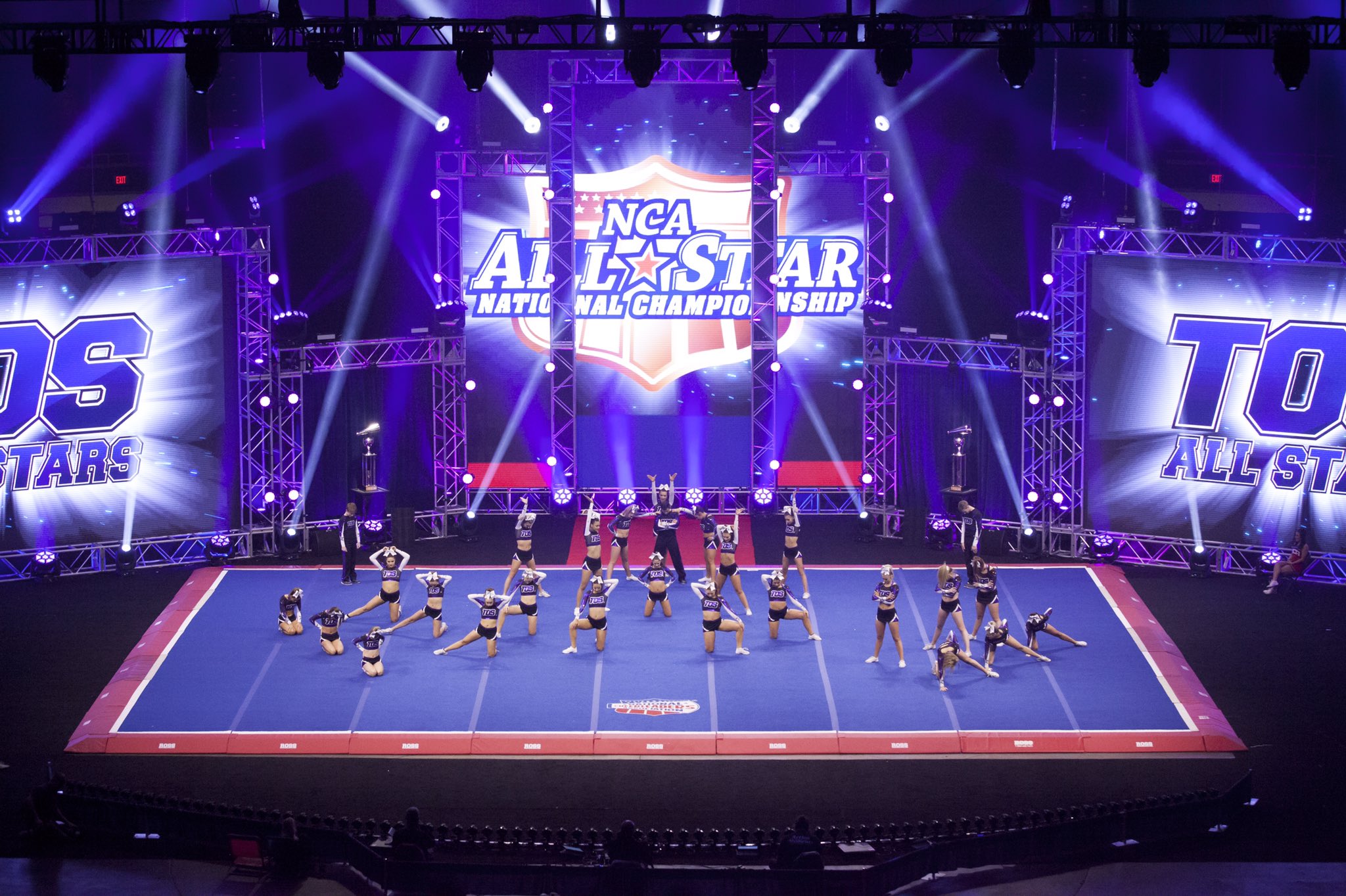
Events connected to organizations such as the National Cheerleaders Association began drawing teams from across the country to compete on a national stage. Among them, NCA Nationals in Dallas emerged as one of the defining championships in cheerleading. Varsity Spirit acquired NCA in 2004.
The event helped establish the format and culture of modern competitive cheerleading.
Teams trained year round for the opportunity to perform at the championship, which is now the largest cheerleading competition in the world. The routines became more athletic and sophisticated each season, pushing the boundaries of what athletes could accomplish on the mat.
Packed arenas, elaborate production, and national recognition gave cheerleading a stage it had rarely experienced before.
The growth of competitive cheerleading aligned with Webb’s vision for the sport.
He believed cheerleading deserved the same kind of platform and respect afforded to other athletic activities. Over time, that belief helped reshape the expectations for the sport.
Building Varsity Spirit
As camps and competitions expanded, Webb brought multiple pieces of the cheerleading business together under the umbrella of Varsity Spirit.
The company grew rapidly through the 1980s and 1990s. Varsity organized competitions, operated camps, produced apparel, and worked closely with programs across both school and all-star cheerleading.
The result was the creation of a comprehensive ecosystem around the sport.

Athletes attended summer camps, competed at regional and national championships, and purchased uniforms and equipment through businesses connected to the same network. The approach helped standardize many aspects of cheerleading while expanding its reach.
By the early 2000s, Varsity had become the most influential organization in cheerleading.
The scale of the industry surrounding the sport had grown dramatically. Competitions filled convention centers and arenas, and the number of athletes participating in competitive cheerleading continued to rise each year.
The Business Expands
As the cheerleading industry grew, so did the business Webb had built around it.
In 2011, Webb sold the company to Herff Jones, the school awards and regalia supplier, and became chief executive of the combined organization, which later rebranded as Varsity Brands. The enterprise continued expanding and acquired sports apparel company BSN Sports in 2013.
Private equity firms soon took notice of the growing industry.
In 2014, Charlesbank Capital Partners acquired Varsity Brands in a deal valued at roughly $1.5 billion. Four years later, Bain Capital purchased the company for approximately $2.5 billion. In 2024, Bain sold a majority stake in Varsity Brands to KKR in a transaction valued at about $4.75 billion.
The series of deals underscored the financial scale of the cheerleading industry that had grown from Webb’s original camp business.
Webb personally earned nine figures from the transactions.
Yet he later acknowledged the complexity of selling a company built around a sport he had helped shape.
“Once you are on that treadmill,” Webb told The New York Times Magazine in 2024, “it’s almost impossible to go back.”
The growth of Varsity also sparked criticism who argued that the company had become too dominant within cheerleading, controlling too many aspects of the sport through its competitions, apparel businesses, and affiliated organizations. Antitrust lawsuits accused the company of suppressing competition and inflating prices.
Varsity and Bain Capital ultimately agreed to settle a major antitrust case for $82.5 million in 2024, following an earlier settlement valued at $43.5 million.
“This was a company that started from zero,” he told Sportico in 2021. “It started from my apartment with me and one other person. It grew to be a large organization.”
Turning Toward the Olympics
In later years Webb focused heavily on the international future of cheerleading.
Through the International Cheer Union, which he founded and served as president, Webb worked to organize national federations across the world and positioned cheerleading as a recognized global sport.

The effort reached a major milestone in 2021 when the International Olympic Committee granted provisional recognition to cheerleading.
Two years later, the U.S. Olympic and Paralympic Committee recognized USA Cheer as an affiliate organization.
For Webb, Olympic recognition represented the culmination of a long effort to legitimize the sport.
Webb spent his life transforming cheerleading from a sideline school activity into one of the fastest growing sports in the world.
Looking Back
In recent years Webb had begun reflecting publicly on his career and the evolution of cheerleading.
Production company September Club announced in 2025 that it had begun work on a documentary examining Webb’s life and the industry he helped create. The project aimed to tell the story of how cheerleading evolved from school spirit traditions into a global competitive sport.
The documentary was expected to premiere in 2026, though its current status is unclear following Webb’s death.
Webb also pursued interests outside the sport. He became involved in conservative media and politics, serving as chairman of the outlet Human Events and authoring the book American Restoration. At one point he expressed interest in running for political office in Tennessee.
Yet cheerleading remained the defining work of his life.
Over more than five decades, the sport evolved from a small community of sideline performers into a global competitive activity involving millions of athletes.
Jeff Webb helped build that transformation.
The camps, competitions, and championships that define cheerleading today reflect a system he and his team at Varsity spent decades constructing.
And long after his passing, the sport will continue to grow inside the world he helped create.